Tranche 2, plainly · The money question, part 2
In part one we met the Impact Analysis — the government's own costing of these reforms, rated exemplary by its independent checker. Now the two numbers everyone quotes from it: twenty-eight thousand six hundred and fifty dollars upfront, and twenty-three thousand two hundred and fifty a year. We checked both against the document's pages. Here is what we found.
The two figures most quoted for Tranche 2. In the published Impact Analysis, $28,650 is the upfront estimate for one turnover band — businesses earning $200k to $2m. The widely quoted $23,250 does not appear in the document.
Find your band
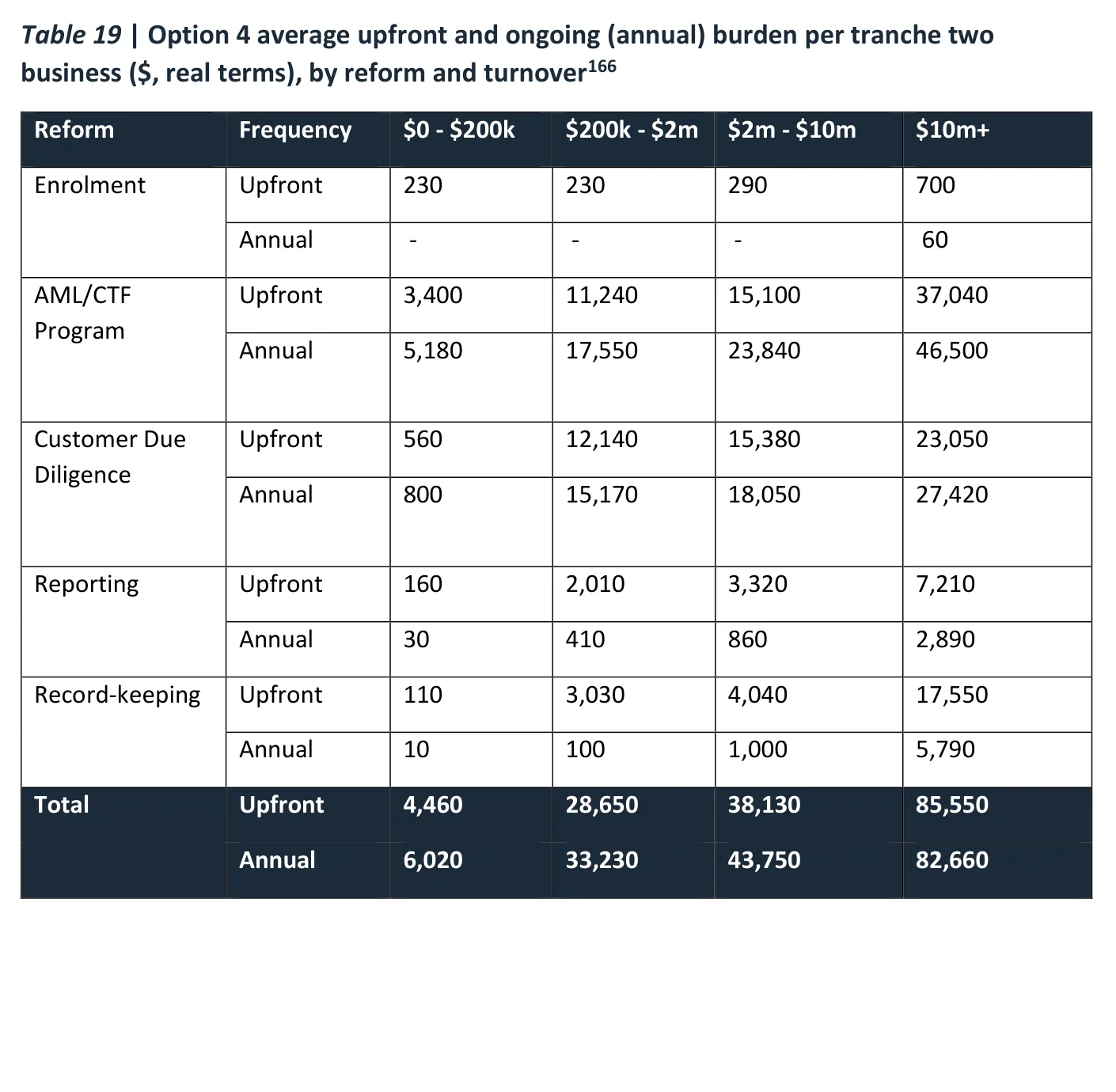
Here is Table nineteen again — printed page one hundred and fifteen of the Impact Analysis, Reforming Australia's anti-money-laundering and counter-terrorism financing regime. Look at the bottom row. The smallest firms — turnover under two hundred thousand dollars — are estimated at four thousand four hundred and sixty upfront, and six thousand and twenty a year. The famous twenty-eight thousand six hundred and fifty? That is the upfront average for the two-hundred-thousand to two-million band — and that band's annual figure is thirty-three thousand two hundred and thirty. Not twenty-three two-fifty. The figures climb with size because bigger firms have more customers to check. Find your band. It is probably not the one the seminar quoted at you.
One number describes nobody

So when a seminar, an article, or a sales page quotes you one number for ninety thousand wildly different businesses, you now know what the source actually contains: a banded table of estimates, priced on traditional methods — professional drafting, manual processes, external advice — and built before the final Rules even existed. Your number is set by your services, your volume, and your customers' complexity. Not by a headline figure. And certainly not by one that isn't in the document.
Where the real money lives

So where does the money actually go? Setup is mostly one-time: scoping your services, the risk assessment, the policies, enrolment and training. The recurring cost — the one that matters — is customer due diligence, because it scales. Your real cost is roughly your customers per year, times the cost of each check under the method you choose. That per-check number is the one to watch.
The law's own discounts

And the law itself reduces the bill — twice, in its own words. Your risk assessment and policies must be appropriate to the nature, size and complexity of your business: a three-person practice is not merely allowed a smaller program, the statute calibrates to it. AUSTRAC's starter kits are free and official. And in real estate deals, the Rules even let professionals in the same transaction rely on one another's checks.
Where money disappears

Where does compliance money actually disappear? Manual work. Re-typing the same details. Chasing documents. Rebuilding stale paperwork before an audit. Records are cheap when you write them at decision time — and expensive when you reconstruct them years later. The habit is the saving.
Read vendor claims carefully — including ours

So when someone quotes you the scary averages and then a price, ask four questions. What does each check actually cost, at your volumes? Do you own your program — can you export it? Do your records survive the full seven years if you leave? And where do the tool's legal statements come from? Ask those of every vendor. Including us.
There is no $23,250 bill.

So here is the honest reframing — stronger than we expected when we started checking. There is no twenty-three thousand dollar bill waiting for you. That number is not even in the document. The right question was never how to avoid it. It is: which obligations create work for a business like yours, how much of that work scales with your volume — and what each unit of it costs under the method you choose.