Tranche 2, plainly · The money question, part 1
Before this law reached Parliament, the government had to write down what it would cost. Not a guess in a seminar — a formal document, checked, certified and published. It still exists, and you can download it tonight. This is part one of the money question: what that document is, and what it actually says.
Where the cost numbers come from

First, what this document is. When the Australian Government proposes major regulation, it must publish an Impact Analysis — the problem it is trying to solve, the options it considered, and what each option would cost the people being regulated. For the 2024 reforms, the Attorney-General's Department wrote that analysis — titled, in full, Reforming Australia's Anti-Money Laundering and Counter-Terrorism Financing Regime — with consultants Nous Group building the cost model underneath it.
Checked, certified, published

And it wasn't just published — it was examined. The Office of Impact Analysis, inside the Department of the Prime Minister and Cabinet, formally assessed it and rated the quality of the analysis Exemplary — their word. It was certified at deputy-secretary level and released in September 2024, alongside the Bill, at oia dot pmc dot gov dot au — with the assessment letter and the certification sitting right beside it. This is a serious document, done properly. Which is exactly why it deserves to be quoted properly.
Implementing Option 4 is estimated to result in an additional regulatory burden for businesses of $13.9 billion over 10 years. This includes estimates of costs for changes in staffing effort to implement or deliver on regulatory obligations, external advice, or investment in system costs. Impacts will vary depending on the industry and size of the business.
The table everyone quotes from
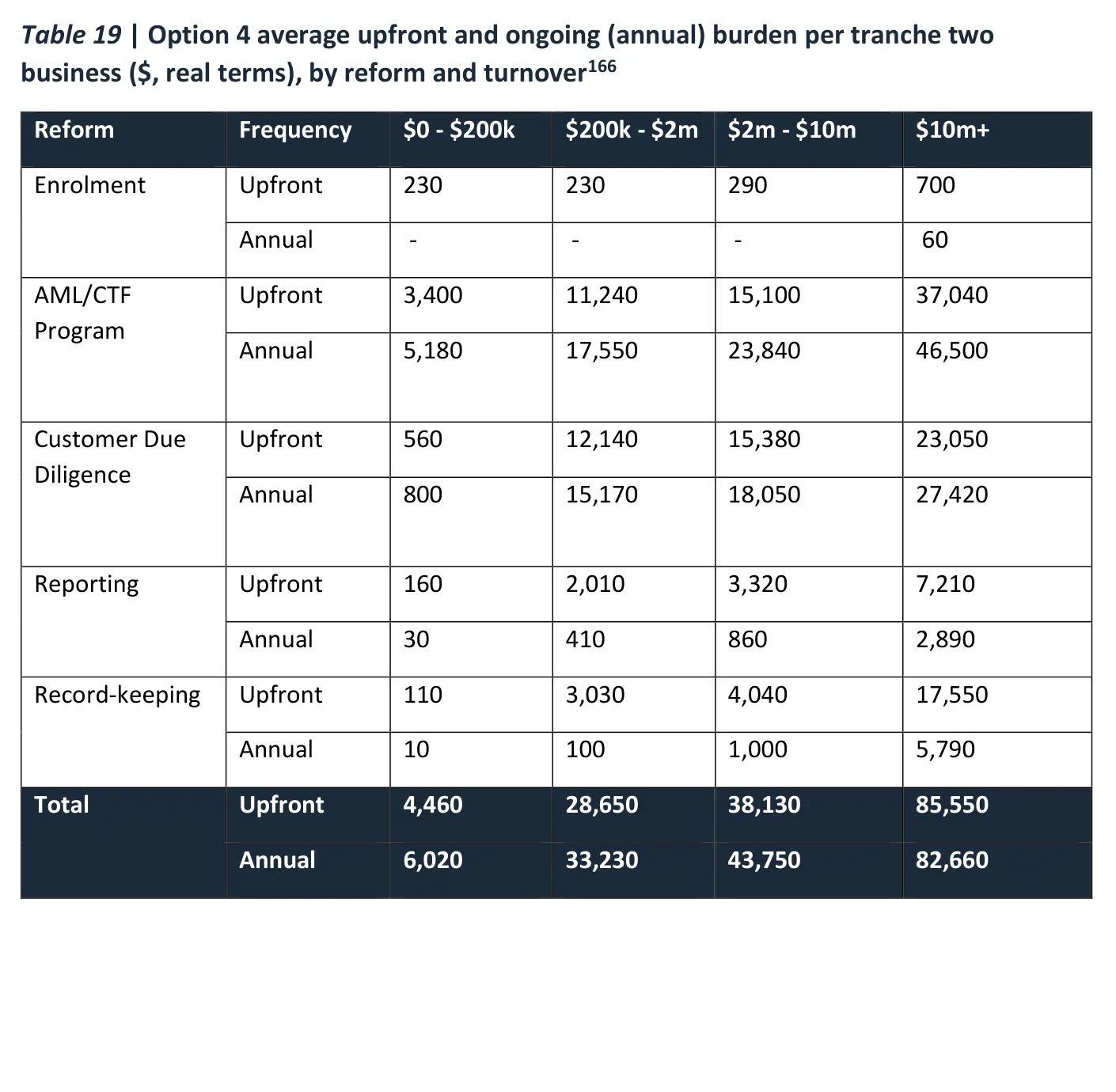
And here is the table the famous per-firm numbers come from — Table nineteen, at printed page one hundred and fifteen of that same document, Reforming Australia's anti-money-laundering and counter-terrorism financing regime — shown here from its own pages. The rows are the obligations: enrolment, the program, customer due diligence, reporting, record-keeping. The columns are business sizes, by annual turnover. And along the bottom, the totals: four and a half thousand dollars upfront for the smallest firms, rising band by band as businesses get bigger. Keep this table in mind — it is the whole story of part two.
The details of the reforms are not yet finalised as the AML/CTF Rules will build on the principles in the Act and provide further detail on how such obligations may be achieved. As such, the operational impact of the reforms is difficult to quantify, particularly for tranche two entities who have no experience with the AML/CTF regime. Estimates of regulatory burden therefore reflect the best efforts and understanding of the affected stakeholders.