Selling jewellery and precious goods, and where AML/CTF touches it
The threshold here is not what most people assume. It is not about how expensive the piece is. It is about how much of it the customer paid in cash.
Start here
What this service is
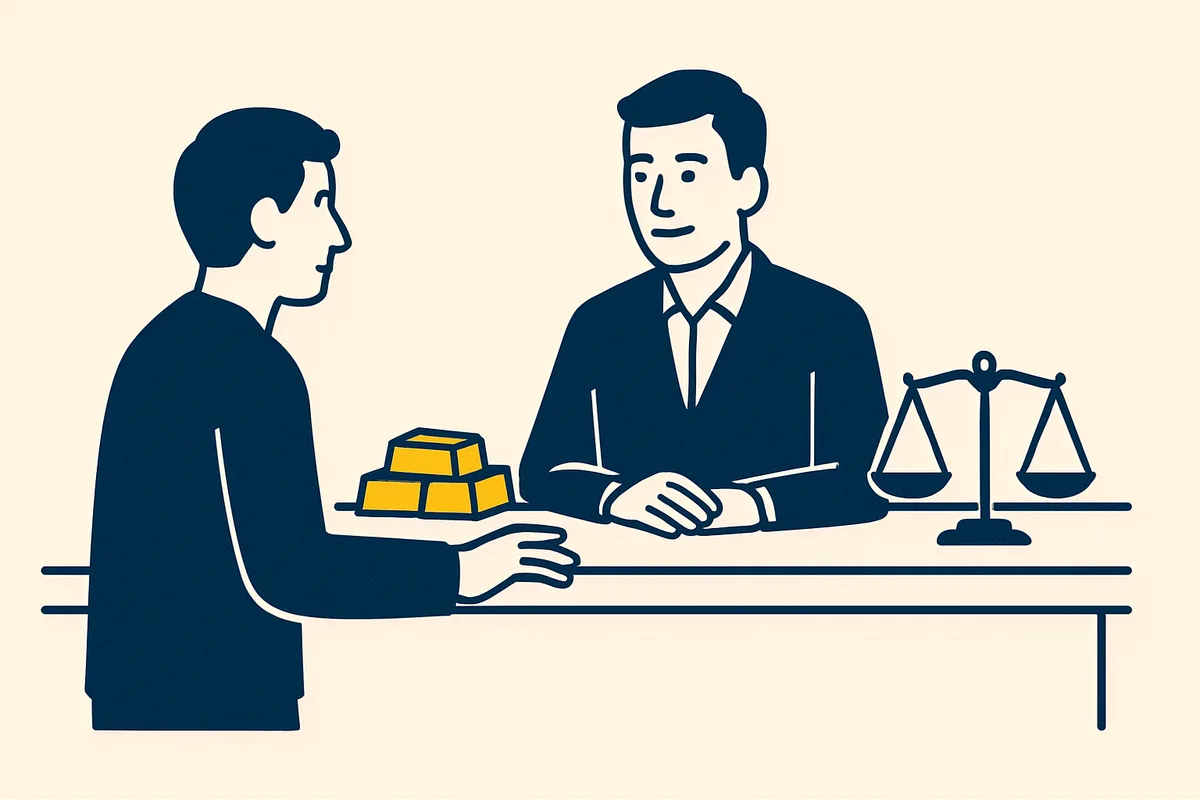
If you buy or sell precious metals, precious stones or precious products as a business, and a customer pays with $10,000 or more in cash or virtual assets, you are providing a designated service.
“Precious products” is defined widely. It reaches jewellery, watches and objects of personal adornment — so this item is not only for wholesalers and gem traders. It is for retail jewellers.
It is also worth saying what this is not. Bullion is a separate service with its own threshold that works the other way round. See item 1 if you deal in bars and coins.
What counts as precious
| Category | What it reaches |
|---|---|
| Precious metal | Gold, silver, platinum and the other metals the Act names |
| Precious stones | Diamonds and other gemstones |
| Precious products | Defined widely in s 5A — reaches jewellery, watches and objects of personal adornment |
| Any combination | A stone set in metal is still within the item |
The shape of it
Four things worth fixing in your head
Of physical currency or virtual assets — not of the sale price
Cash and crypto count. Card, bank transfer and finance do not
Several transactions that are linked, or appear linked, are added up
Jewellery manufacturing businesses in Australia, a $2.8bn industry
The part almost everyone gets wrong
The $10,000 is cash, not price
Read the item carefully and the threshold attaches to the transfer of physical currency or virtual assets — not to the value of what was sold.
So a $60,000 ring paid for entirely by card is not item 2. No cash moved. The same ring, with $10,000 of the price paid in notes, is.
This catches shops both ways. Some carry the obligation without realising, because their expensive sales are on card and they assume a high price means a check. Others run checks on every large sale that never needed one.
And the item adds up linked transactions. Several purchases that are linked, or that appear linked, are counted together — so three $4,000 cash purchases in a week are not three separate small sales.
| The sale | Cash or virtual assets | Position |
|---|---|---|
| A $60,000 ring, paid entirely by card | $0 in cash | Not item 2 |
| A $60,000 ring, $10,000 cash and the rest by card | $10,000 in cash | Item 2 — caught |
| A $12,000 watch, paid by bank transfer | $0 in cash | Not item 2 |
| A $12,000 watch, paid in cash | $12,000 in cash | Item 2 — caught |
| A $9,000 bracelet, paid in cash | $9,000 in cash | Under the threshold |
| Three $4,000 cash purchases in a week that appear linked | $12,000 in cash | Item 2 — linked transactions are added |
Compare that with bullion, where the threshold is $5,000 of metal value and the payment method is irrelevant. The two items sit side by side in the same table and work in opposite ways.
What actually gets checked
Six checks, and two of them are about the cash
This is a counter business, so the checks have to work in the time it takes to sell something. The two that need thought in advance are the cash question and the linked sales — both are easier with a process than with a judgement call at the till.
| The check | What is required | How it is usually done | What stays in the file |
|---|---|---|---|
| Identify the customer | Full name, date of birth and residential address of the buyer or seller | Licence or passport, at the counter or by digital check | What was collected and how it was verified |
| Look through entities | If the customer is a company or trust, who owns or controls it | ASIC extract, trust deed | Who they are and the document relied on |
| Screen for PEPs and sanctions | Whether the customer is politically exposed, and a check against the DFAT Consolidated List | A screening tool, or a manual DFAT search | The result and its date |
| Ask about the cash | Where a large cash payment came from, in higher-risk cases | A conversation at the counter, recorded afterwards | The explanation and any evidence sought |
| Rate the risk | Assess and record the ML/TF risk of the customer | Your program’s risk factors — cash, resale-friendly goods and anonymity all raise it | The rating and the reasons |
| Watch for linked sales | Identify transactions that are linked, or appear linked | Repeat visits, a series of purchases under the line, several family members buying together | What you noticed, when, and what you did |
Records are kept for 7 years. A cash payment of $10,000 or more may also trigger a threshold transaction report, which is a separate obligation from customer due diligence.
The provision itself
Table 2, item 2, in the Act’s own words
“buying or selling one or more of the following items in the course of carrying on a business, where the purchase involves the transfer of physical currency or virtual assets (or a combination of physical currency and virtual assets) with a total value of not less than $10,000, whether the purchase is made in a single transaction or in several transactions that are linked or appear to be linked: (a) precious metal; (b) precious stones; (c) precious products; (d) any combination of any 2 or more of the items referred to in paragraphs (a) to (c)”
Customer: the buyer or the seller (as the case may be). Anti-Money Laundering and Counter-Terrorism Financing Act 2006 (Cth), s 6(3) table 2, item 2 — Compilation No. 62 (C2026C00274). “Precious product” is defined in s 5A.
The words that decide everything are “where the purchase involves the transfer of physical currency or virtual assets … with a total value of not less than $10,000”. Everything else in the item describes what was sold; that clause describes how it was paid for, and it is the one that makes the service.
The thirteen designated services
One article for each service you can select when you enrol
13 of 13 written so far. The rest are in progress.
- ConveyancingEvery step of a settlement, and how CDD differs from the VOI you already do.Table 6, item 1
- Selling a businessWhen a company or trust changes hands.Table 6, item 2
- Client moneyHolding or controlling someone else’s money or property in a transaction.Table 6, item 3
- Equity and debt financingRaising money for a company or legal arrangement.Table 6, item 4
- Shelf companiesSelling or transferring a company created to be sold.Table 6, item 5
- Company and trust formationCreating or restructuring a company, trust or partnership.Table 6, item 6
- Director and trustee rolesActing as, or finding someone to act as, a director, trustee or attorney.Table 6, item 7
- Nominee shareholdersHolding shares in your name for somebody else.Table 6, item 8
- Registered officeLetting a client use your address as their registered office.Table 6, item 9
- Real estate agentsThe agent’s customer is both sides of the deal — and the two sides start at different moments.Table 5, item 1
- Property developersSelling your own stock with no agent in between, and why that changes who the customer is.Table 5, item 2
- BullionGold, silver, platinum and palladium, and the $5,000 exemption.Table 2, item 1
- Jewellers and dealersyou are hereWhy the $10,000 line is about how the customer pays, not what they buy.Table 2, item 2
Sources
Where every figure here comes from
Data as at 27 September 2026.
- Anti-Money Laundering and Counter-Terrorism Financing Act 2006, s 6(3) table 2 and s 5A · Federal Register of Legislation · Compilation No. 62 (C2026C00274)Item 2, quoted verbatim on this page, and the s 5A definition of “precious product”.
- Dealers in precious metals and stones · AUSTRAC · Guidance, current at Sep 2026AUSTRAC’s guidance for the sector.
- Jewellery Manufacturing in Australia · IBISWorld · 20261,440 businesses in a $2.8 billion industry.
- AML/CTF program starter kits · AUSTRAC · Dealer kit, 2026The sector kit for dealers.
Before you rely on this
This content is general information only. It is not legal, financial or compliance advice. Organisations should check AUSTRAC guidance, legislation, their own AML/CTF Program and professional advice where needed.
- Whether transactions are linked, or appear linked, is a judgement on the facts. Record how you reached it.
- Threshold transaction reporting for cash of $10,000 or more is a separate obligation with its own rules and timing. This page does not cover it.
- Current as at 27 September 2026.
Lex-AML supports compliance workflows and record keeping. It does not provide legal advice, does not guarantee compliance, and does not replace professional judgement or advice from a qualified AML/CTF adviser or legal professional.
GetPost Labs is a technology company. We are not a law firm and not a compliance adviser, and this page is not a substitute for either.
We build Lex-AML. To build it properly we had to understand these obligations the way the people carrying them do, so we researched them with small and medium practices across the affected sectors — how the work actually runs, where the law lands inside it, and which questions were hardest to get a straight answer to. Publishing what we found is how we check that we have understood a requirement before we build for it.
That understanding is also what we bring to a conversation. No two practices run a matter the same way, and tooling that assumes one way of working fits almost nobody. We would rather start from how you already work — your intake, your file, your sign-off, the software you already pay for — and shape the compliance work around that than hand you a process and ask you to adopt it.
So this is an offer of capability, not a pitch. If Lex-AML turns out to fit your practice, we would like to work on it with you. If it does not, what is written on this page stands on its own, and every source it rests on is listed above so you can check it yourself.